
You worked hard for your home. The last thing your family should face after losing you is a lengthy court process just to keep it. A Florida Lady Bird Deed is one of the simplest, most affordable tools in estate planning — and most Florida homeowners have never heard of it. Here is what it is, how it works, and whether it belongs in your plan.
Key Takeaways
- A Florida Lady Bird Deed transfers your property to beneficiaries automatically at death, bypassing probate entirely
- You keep full control during your lifetime: sell, refinance, rent, or change beneficiaries without anyone’s permission
- It preserves Florida homestead protections and provides a step-up in basis for your heirs
- It is one of the most cost-effective probate avoidance tools available to Florida homeowners
- It is not ideal for every situation: minor beneficiaries, special needs planning, or complex estates may require a trust
- An attorney should prepare your deed to avoid technical mistakes that surface after you pass away
What Is a Florida Lady Bird Deed?
A Florida Lady Bird Deed, also called an Enhanced Life Estate Deed, is a legal document that allows you to transfer your real estate to your chosen beneficiaries automatically at death, without going through the probate court process.
Think of it as a “pay-on-death” designation for your home. You remain the owner with full legal authority during your lifetime. When you pass away, your named beneficiaries simply record your death certificate and the property is theirs. No court. No delay. No probate fees.
The name traces back to President Lyndon B. Johnson, who reportedly used this type of deed to transfer property to his wife, Lady Bird Johnson. The term is informal but widely recognized by Florida courts and title companies.
How Does a Florida Lady Bird Deed Work?
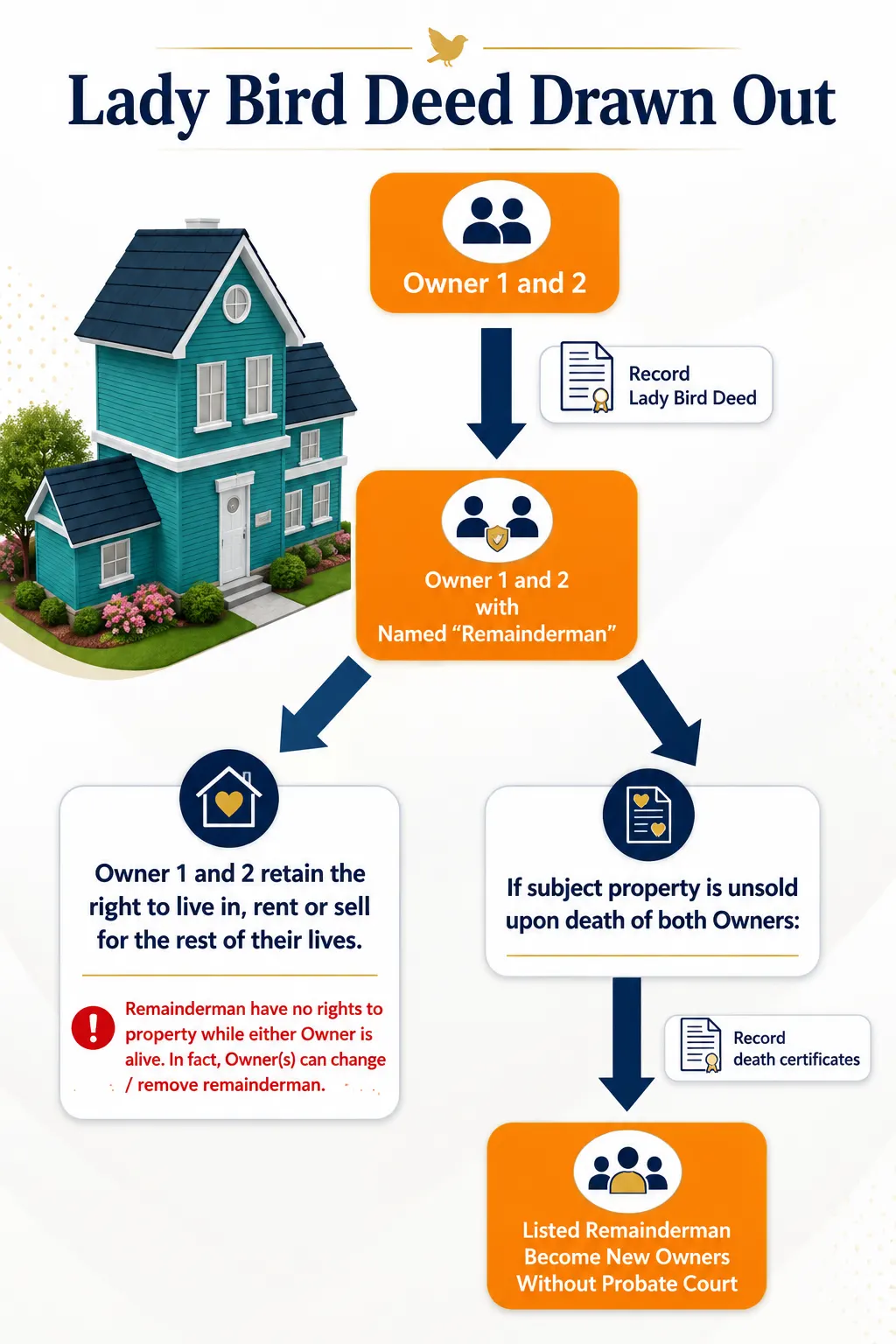
A Florida Lady Bird Deed splits ownership into two parts: the life estate you retain during your lifetime, and the remainder interest that passes to your named beneficiaries at your death.
What makes a Florida Lady Bird Deed different from a traditional life estate deed is the enhanced power you keep as life tenant. During your lifetime you can:
- Sell the property without beneficiary consent
- Refinance or mortgage the property
- Lease or rent the property
- Revoke the deed and change your beneficiaries at any time
Your beneficiaries have no current ownership rights. Their personal situations, creditors, divorce proceedings, or lawsuits cannot affect your home while you are alive.
When you pass away, ownership transfers automatically. Your beneficiaries record an affidavit and certified death certificate with the county clerk. No probate petition is required.
What Does a Valid Florida Lady Bird Deed Require?
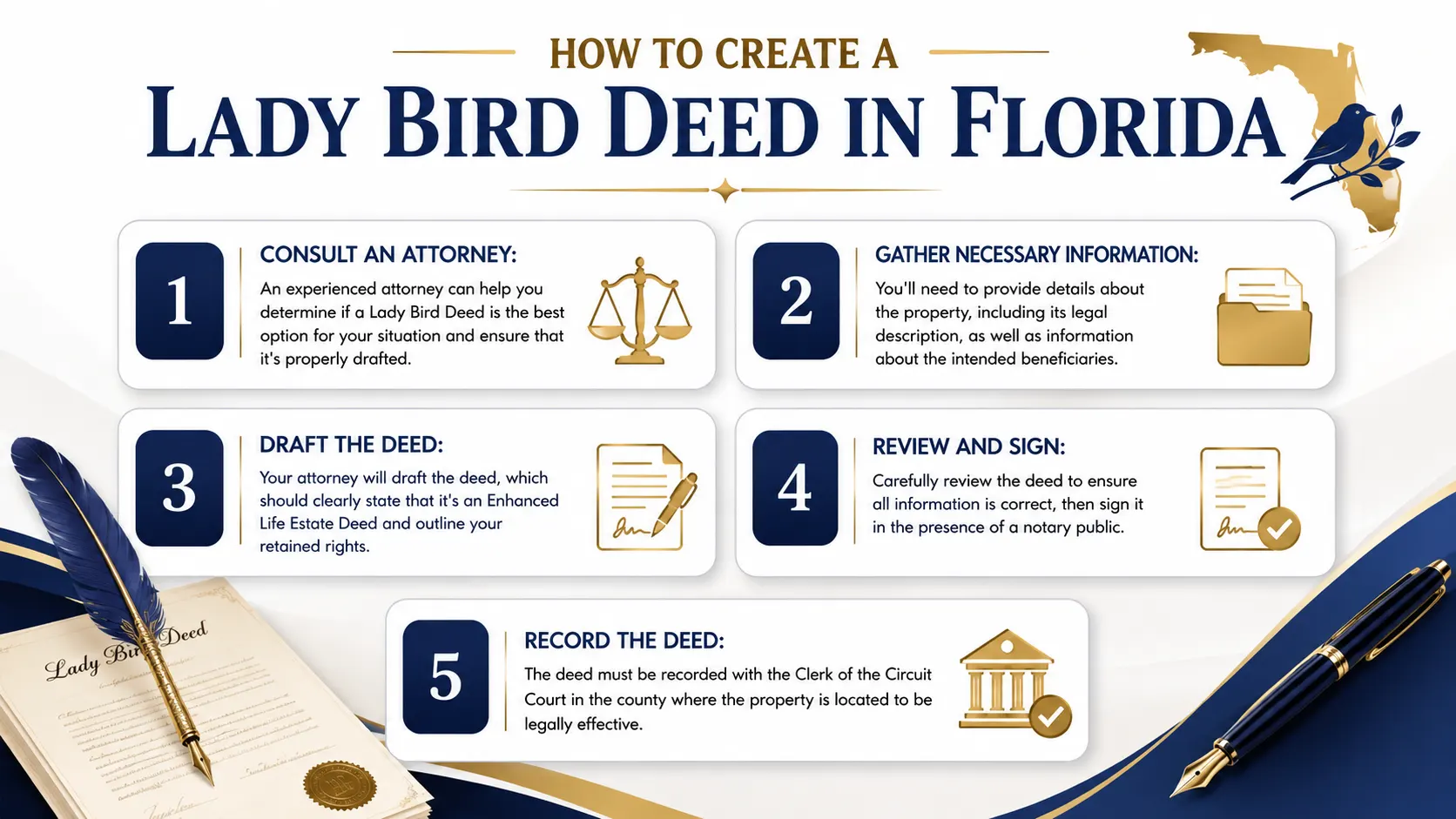
A properly prepared Florida Lady Bird Deed must include:
- Identified grantor whose name matches the existing deed on record
- Enhanced life estate language expressly granting you the power to sell, mortgage, or convey without beneficiary consent
- Named remainder beneficiaries with contingent beneficiaries in case a primary beneficiary predeceases you
- Legal property description from the current deed of record (a street address is not sufficient)
- Homestead language if applicable, which may require your spouse to sign
- Proper execution with two witnesses and a notary, then recorded with the county clerk
Missing or imprecise language can invalidate the deed or create title problems your family discovers years later when trying to sell or refinance.
How Does a Florida Lady Bird Deed Compare to a Regular Life Estate Deed?
With a traditional life estate deed, your beneficiaries receive a vested interest immediately upon signing. You cannot sell or refinance without their signatures. You cannot change beneficiaries without their cooperation. Their creditors can attach liens to their vested interest.
With a Florida Lady Bird Deed, beneficiaries receive nothing until your death. You retain the practical equivalent of full ownership. Their personal legal problems do not touch your property during your lifetime.
For most Florida homeowners, this distinction makes the Lady Bird Deed a clearly superior option.
How Does a Florida Lady Bird Deed Compare to a Living Trust?
Both avoid probate. The right choice depends on your situation.
A Florida Lady Bird Deed works better when:
- You own one Florida property with a straightforward plan
- You want a simple, low-cost solution
- Your beneficiaries are adults without special needs or creditor issues
A revocable living trust works better when:
- You own property in multiple states
- You have minor children or beneficiaries with special needs
- You want detailed instructions for managing and distributing assets
- You want to plan for incapacity in addition to death
A Lady Bird Deed handles real estate only. A trust can hold bank accounts, investments, and other assets. For a comprehensive estate plan, a trust is often the more complete vehicle.
How Does a Florida Lady Bird Deed Interact with Florida Homestead?
Florida homestead law adds complexity to any deed involving your primary residence.
If you are single, a Lady Bird Deed on your homestead is generally straightforward. Homestead protections continue, and the property transfers outside probate at your death.
If you are married, Florida’s constitution restricts how you can transfer homestead property. Your spouse will generally need to sign the deed for it to be valid.
Homestead protections that continue with a Florida Lady Bird Deed include your Save Our Homes assessment cap, homestead exemption for property tax purposes, and constitutional creditor protection.
If you are survived by a spouse or minor child, Florida homestead descent rules may override your deed regardless of what it says. This is one of the most important reasons to work with an attorney on any homestead deed.
Can Medicaid Take Your House If You Have a Florida Lady Bird Deed?
Generally, no. This is one of the strongest arguments for using a Florida Lady Bird Deed in estate planning.
Florida’s Medicaid estate recovery program is limited to assets that pass through probate. Because a Florida Lady Bird Deed transfers property outside of probate, the home is typically not subject to estate recovery after your death.
Additionally, because you retain the full right to revoke the deed and sell the property during your lifetime, the transfer is generally not treated as a completed gift for Medicaid lookback period purposes, meaning it typically does not create a disqualification period for Medicaid eligibility.
Medicaid rules are complex and change frequently. Always consult a qualified estate planning attorney before relying on this strategy.
What Are the Tax Consequences of a Florida Lady Bird Deed?
Step-up in basis. Your beneficiaries receive a stepped-up cost basis equal to the fair market value at your date of death. If they later sell, capital gains are calculated from that date-of-death value, not your original purchase price. For a home that appreciated significantly over decades, this can save your heirs substantial capital gains taxes.
No gift tax. Because you retain the right to revoke and sell, the transfer is not a completed gift during your lifetime. No gift tax return is required and no lifetime exemption is used.
No documentary stamp tax on the death transfer when your beneficiaries record the death certificate.
Homestead exemptions continue during your lifetime without interruption.
What Are the Disadvantages of a Florida Lady Bird Deed?
A Florida Lady Bird Deed is not suitable for every situation.
It may not be ideal when:
- A beneficiary is a minor child (minors cannot directly hold title to real estate in Florida)
- A beneficiary has special needs or receives government benefits that could be affected by an inheritance
- You anticipate family conflict among multiple beneficiaries
- A beneficiary has significant creditor problems or is going through a divorce
- You own property in multiple states and want a unified plan
Not all Florida title insurance companies are equally comfortable with Lady Bird Deeds. A deed that does not satisfy major title underwriters’ requirements can create obstacles when beneficiaries try to sell or refinance after your death.
A Lady Bird Deed also provides no instructions for managing the property or resolving disputes among multiple beneficiaries. For complex situations, a revocable living trust is often a better solution.
How Much Does a Florida Lady Bird Deed Cost?
Attorney fees in the Tampa Bay area for preparing a Florida Lady Bird Deed typically range from a few hundred dollars to approximately one thousand dollars, depending on complexity.
This is significantly less than the cost of establishing a full revocable living trust.
The cost of a deed with technical errors, however, can far exceed any attorney fee. A deed rejected by title companies or requiring litigation to correct after your death cannot be fixed by you. Online DIY templates carry real risk when the enhanced life estate language or homestead provisions are not precisely drafted.
Frequently Asked Questions About Florida Lady Bird Deeds
What is the disadvantage of a Lady Bird Deed in Florida?
The main disadvantages are that it covers real estate only, it does not work well when beneficiaries are minors or have special needs, and title insurance companies have specific requirements for the deed language. For complex estates, a revocable living trust is typically more complete.
Do you pay taxes on a Lady Bird Deed in Florida?
No gift taxes apply when you sign the deed. Your beneficiaries receive a stepped-up basis at your death, reducing capital gains taxes if they sell. No documentary stamp taxes apply to the death transfer. Your homestead exemptions continue during your lifetime.
How much should a Lady Bird Deed cost in Florida?
Attorney fees typically range from a few hundred to approximately one thousand dollars depending on complexity. Recording fees add a modest additional cost. DIY templates are available but carry significant risk if the language is not precisely drafted for Florida law and your specific situation.
Can Medicaid take your house if you have a Lady Bird Deed?
Generally, no. Florida Medicaid estate recovery is limited to probate assets. A Florida Lady Bird Deed transfers property outside of probate and is generally not treated as a disqualifying transfer for Medicaid eligibility. Consult a qualified attorney before relying on this strategy, as rules are complex and subject to change.
Why is it called a Lady Bird Deed?
The name comes from President Lyndon B. Johnson, who reportedly used this type of enhanced life estate deed to transfer property to his wife, Lady Bird Johnson. The term is informal and not found in Florida statutes, but is well-recognized by Florida courts and title companies.
Can a Lady Bird Deed be contested in Florida?
Like any deed, it can be challenged on grounds such as lack of capacity, undue influence, or fraud. A properly prepared deed signed by a competent adult with appropriate witnesses and notarization is generally difficult to challenge successfully.
What should you do with a Lady Bird Deed after the owner dies?
Beneficiaries should obtain a certified death certificate and record it with any required affidavit at the county clerk’s office where the property is located. They should then update the property appraiser’s records and apply for any applicable homestead exemptions. No probate proceeding is required.
Is a Florida Lady Bird Deed Right for You?
A Florida Lady Bird Deed is one of the most practical and cost-effective estate planning tools available to Florida homeowners who want to protect their family from the time and expense of probate while keeping full control of their property during their lifetime.
It works best for homeowners with a straightforward estate, adult beneficiaries, and a Florida property they want to pass to the next generation simply and efficiently.
For more complex situations, including Medicaid planning, blended families, minor children, or multi-state ownership, a broader plan that may include a revocable living trust is worth exploring.
The right answer depends on your specific goals, your family, and your assets.